
Building a Coalition with Research & Shared Evidence
Situation
A Detroit-based entrepreneurial hub engaged me to explore expanding its brand into neighborhood locations. Community development organizations across the city had independently identified the same need: affordable, accessible workspace close to home, on commercial corridors struggling with vacancy. The initial scope was a brand expansion study.
As the research progressed, the project took a turn. Seven community organizations were already working on this problem in their own neighborhoods. They didn't need another brand. They needed an operational partner, shared evidence, and a credible plan they could take to funders together.
Complication
Each organization knew its own neighborhood well but had limited operational experience, funding, and capacity Assumptions about demand, pricing, and feasibility varied widely. The concept of "coworking" carried connotations of downtown tech culture. Residents wanted something different: workspace close to home, access to programming, and connection to their existing community.
The research needed to serve two purposes: help TechTown understand its evolving role and give the coalition shared data to act on together.
What I Did
Competitive Landscape Analysis & Secret Shopping
I mapped and benchmarked all 22 collaborative workspaces in Detroit: locations, pricing, amenities, programming, target markets, and community models. The vast majority were clustered downtown. Only 7 of 22 met the 10,000 sq. ft. threshold for financial sustainability. Almost none were designed for specific community needs. The gap was geographic and experiential.
Community Survey
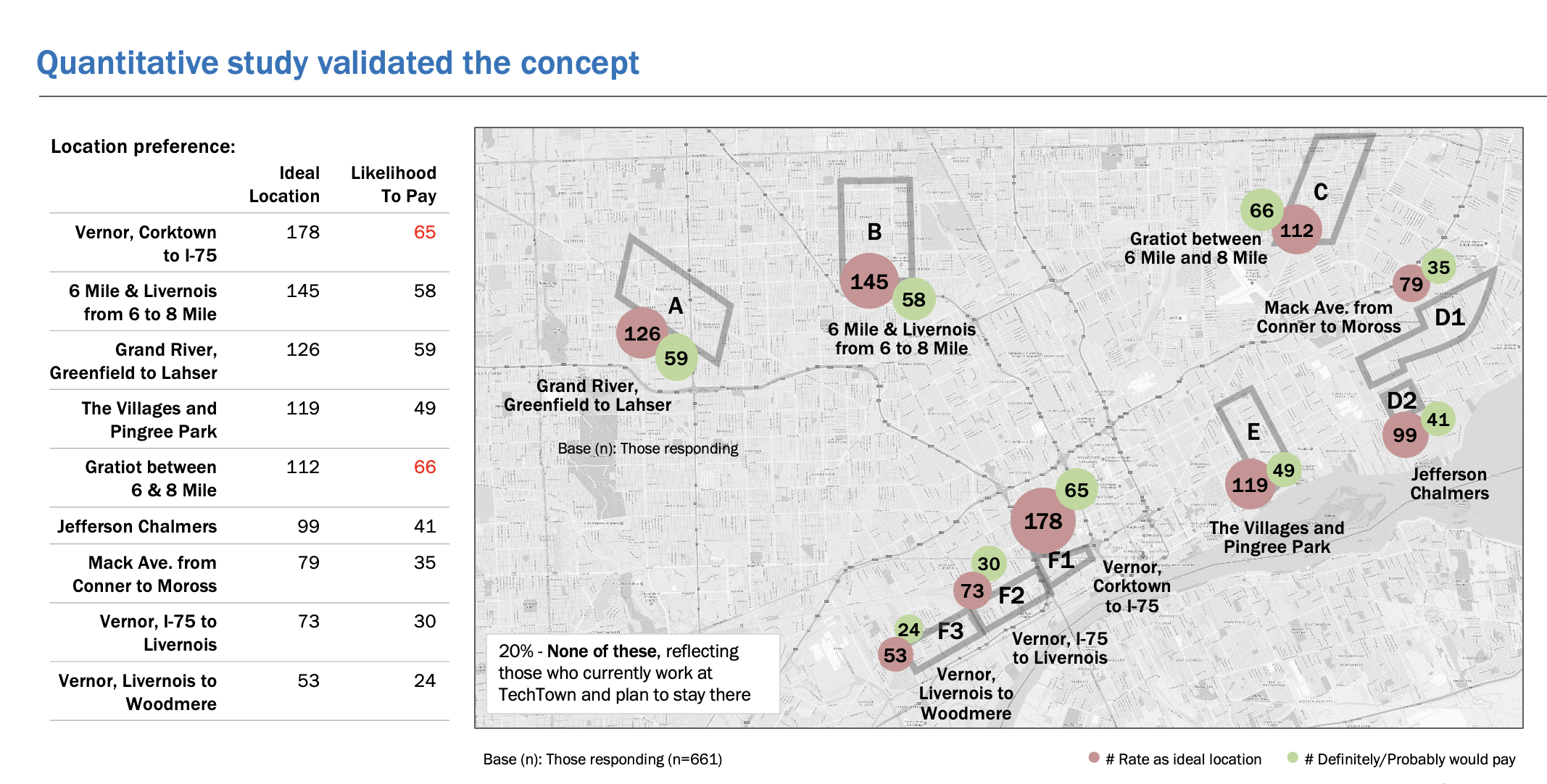
I designed and fielded a 770-person survey across all partner neighborhoods to test the concept, validate demand by location, and understand willingness to pay. Interest was evenly distributed across the city. 87% of respondents already used a secondary workspace at least monthly. 84% valued access to multiple locations. What people wanted was a neighborhood anchor with workspace, programming, and community.
Neighborhood Feasibility Scoring
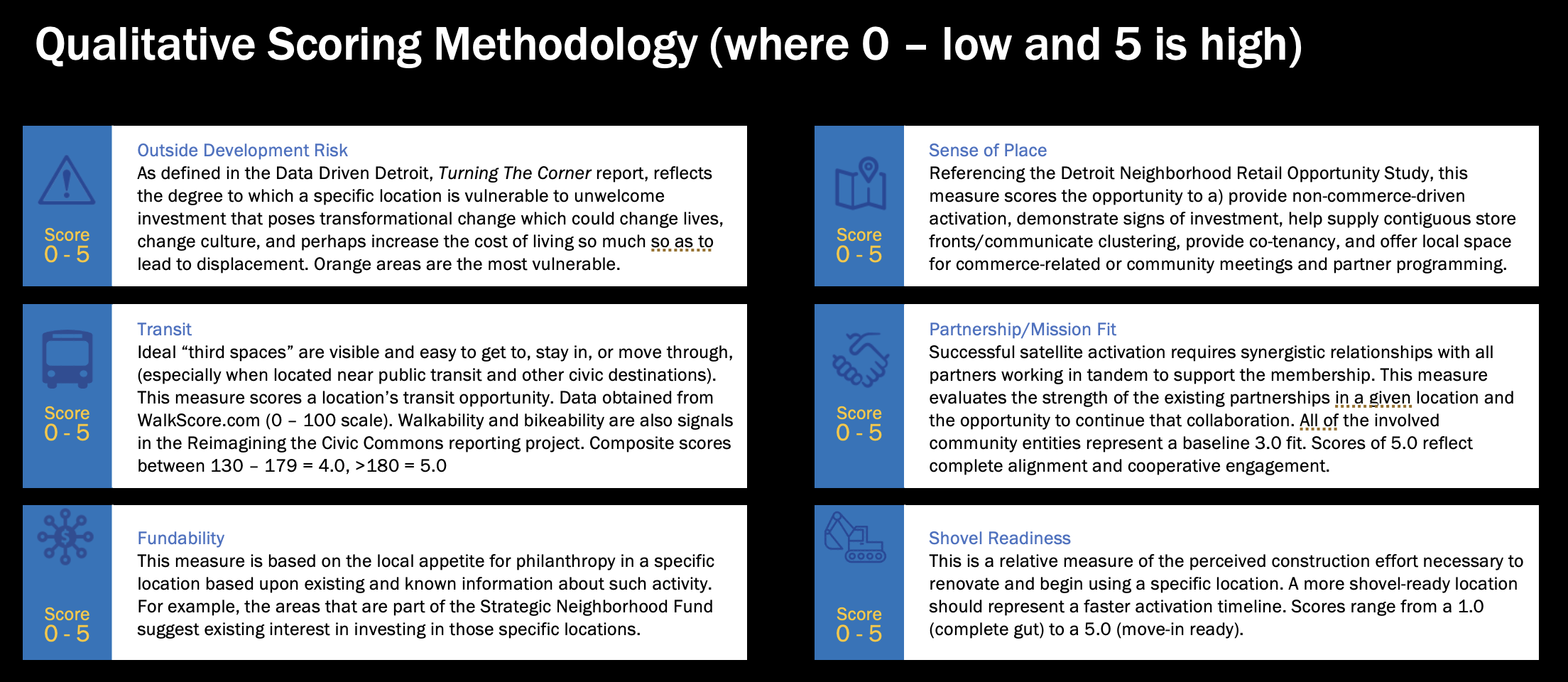
I developed a composite scoring methodology that evaluated each potential location across six dimensions: fundability, sense of place, partner/mission fit, shovel readiness, transit access, and outside development risk. This gave the coalition an evidence-based way to compare neighborhoods and prioritize phased expansion.
Financial Modeling and Scenarios
Working with site-specific construction and operating cost estimates, and in partnership with the Chief Strategy Officer, I developed three phased expansion scenarios that balanced ambition with operational feasibility. Each specified which neighborhoods to launch first, square footage requirements, estimated construction costs, and timeline.
Impact
Scope reframed - Project evolved from brand expansion study to coalition strategy. Research surfaced the shift and gave leadership evidence to act on it.
Demand validated - 770-person survey confirmed citywide interest. 87% already used secondary workspace monthly.
Gap identified - 22 workspaces mapped. Most clustered downtown. Almost none designed for neighborhood community needs.
Decision framework delivered - Composite scoring across six dimensions gave the coalition a repeatable, evidence-based way to prioritize neighborhoods
Coalition enabled - 7 community organizations aligned around shared evidence, feasibility scores, and a phased expansion plan they could take to funders together.
Methods & Deliverables
Competitive landscape analysis | Secret shopping | Community survey design and analysis | Stakeholder engagement | Composite qualitative scoring | Site feasibility assessment | Financial modeling | Scenario planning